Dubrovnik is considered one of the most prominent destinations in the whole Mediterranean Sea. The city is also an important sea port and an important marine trade centre. Dubrovnik embraces a rich history and it was founded in the 7th Century, by some Roman refugees. The first inhabitants built their establishment along the coast and in the following centuries, the city expanded. Dubrovnik had many sovereigns during its existence and was under the protection of Ostrogothic Kingdom, Byzantine Empire and even Venice. For over 300 years, Dubrovnik was a free state. Nowadays, the city is a part of the Croatia country and it still impresses with its great natural and architectural wonders. Below, we will present you the most interesting places to visit, while in Dubrovnik.


Top Dubrovnik Sights

Top Dubrovnik sights – Villas in Dubrovnik
Dubrovnik City Walls
You will notice the city walls, from the moment you walk into the city. They will welcome you right away, with their imposing stance. Even if the walls are not used as a defensive weapon anymore, they still guard the city and provide an amazing sight. A very interesting thing about the city walls is that any tourist can walk on them, for a small fee. Here, you will have the chance to see the whole city from above and to admire the nearby islands. The view is astonishing. The City Walls are surrounding the Old City of Dubrovnik and they are around 1900 meters long. The interesting thing is that they are entirely open to public and you can walk on them. However, a full trip around the walls will usually take around 2 hours, but it definitely worth every second. This is one of the majestic tourist attractions and one of the best-preserved forts in Europe. The wall has 16 bastions and towers and five forts and is the world’s second most appealing outdoor museum. It has 3 entrances:
1. The entrance next to the church of St. Saviour at the Pile entrance to the Old City
2. The entrance next to the church of St. Luke (eastern entrance)
3. The entrance located at the Fort of St. John next to the popular Maritime Museum
While on the walls, you will have the chance of exploring Dubrovnik through a totally new angle – through striking forts that are, in the past, used as a defence of the Dubrovnik Republic. There are five existing forts:
1. Minceta (Minčeta)
2. Bokar
3. St John’s Fort
4. Lovrijenac
5. Revelin
Bokar, Minceta and St. John’s forts were built on the city walls, while Revelin fort free stands in the east and Lovrijenac in the west.

Dubrovnik Sights – Villas in Dubrovnik

Dubrovnik Sights – Dubrovnik City Walls
Fort Minceta
Fort Minceta is the highest Fort, it stands proudly protecting the city from the north and is one of the biggest symbols of the defense of the Dubrovnik’s Republic. The homeland’s flag waves at the peak of the fort at all time, but during the summer, the homeland’s flag gets a companion – the Libertas flag.
Fort Lovrijenac
While walking on the western part of the city walls, you will be able to notice an old vestige, located on a high cliff. That’s the Lovrijenac Fortress. The construction was built by the Venetians, with defensive purposes. The fortress is mainly used during summer festivals, serving as a stage. Lovrijenac was also used for filming the popular TV show “Game of Thrones”.
Fort Bokar
Also called “Zvjezdan” is one of the city forts that is facing the Fort Lovrjenac. Fort Bokar was built in the 15th century and served as a protector of the small city harbour that can be found on the west, the Pile bridge and the moat. Today, this fort exhibits an entire collection of Dubrovnik’s stone fragments.
St. John’s Fort
Built in 1346, St. John’s Fort was the first quadrangular pier tower that was built to protect the main city harbour from enemies coming from east and southeast. Today, the fort serves as an aquarium that is placed on the first floor of the building while on the second floor you’ll find a Maritime Museum of which Dubrovnik is also popular. There’s also a lighthouse known as Porporela at the foot of the fort and is used as a place where locals take a swim or lovers meet. If you climb Porporela, you’ll see the Fort Revelin standing proudly at the entrance to the city.
Fort Revelin
Placed on the east and surrounded by sea on one side and a moat on other 3 sides, this fort was almost impossible to take over thus it had a crucial role through the history of enemy attacks on Dubrovnik. Although it was built somewhat earlier than previous fortress, it reminiscence of forts characteristic for the 16th century. The terrace and the interior are used for the Dubrovnik Summer Festival and concerts held by the Dubrovnik Symphony Orchestra.
Stradun
We cannot talk about Dubrovnik without mentioning Stradun. This is the most important and also the oldest street in the Old Town of Dubrovnik. The street is only 292 meters long and it connects the 2 gates of the city: Pile and Ploce (Ploče. cro.). Even if it’s less than 300 m long, Stradun is full of attractions and interesting monuments. The narrow cobblestone streets are hiding a lot of interesting constructions, cafes and souvenir shops. The Great Onofrio’s Fountain, the Bell Tower and the Sponza, are just a few incredible sites that can be admired on Stradun and worth mentioning, but let’s start with the street itself. The people who want to enter the city of Dubrovnik have two options, two main gates – the western gate at Pile and the eastern gate at Ploce. In ancient times, the drawbridges were always pulled up overnight, in order to prevent enemies and uninvited visitors enter the old Dubrovnik. If you enter the Pile gate, you’ll see city guards still costumed in the ancient uniforms and the first street you’ll see is the main street called Stradun or Placa. It’s the open public place, a favorite meeting place and a promenade where all great processions and festivities are held. Stradun is also the main shopping street with a vast variety of shops, boutiques and antique stores. Basically, it’s the most beautiful street in Dubrovnik and you cannot visit the city without walking through the street. Stradun origins go back to the 11th century and acquired its proper function in the late 12th century when this urban street became a part of the city wall complex. The name of the street Placa comes from the Latin term “Platea communis” which determines that this is the street for all major events, and the name “Stradun” has a Venetian origin which means “a large street”.

Top Dubrovnik sights – Stradun street.

Top Dubrovnik sights – Stradun street.
The Large Onofrio Fountain
One of the most popular monuments found on Stradun is The Large Onofrio Fountain and it’s built in the eastern part of the street. Stradun was named after the constructor who, in the 15th century, built an 11.7-kilometre long water supply system that was used to supply the entire city with water.
The Small Onofrio Fountain
The second, much smaller fountain that Onofrio della Cava built was placed closer to the city bell-tower. Its purpose was to use as a place where people can refresh themselves during hot summer days and, today, The Small Onofrio Fountain still serves its purpose. Many tourists use it to refresh themselves while the bell-tower strikes the hours during the summer season.

Dubrovnik Sights – The Large Onofrio Fountain

Dubrovnik Sights – The Small Onofrio Fountain
City Bell-Tower
The 31-metre high tower with a clock and a bell was built in 1444. The well-known Ivan Rabljan cast the bell in 1509 as well as the famous green men Maro and Baro, who strike on the hour on the bell-tower and repeat striking after 3 minutes.

Dubrovnik Sights – City Bell-Tower
Luza square
The main place of all events in the old Dubrovnik city center is Stradun. Entering the City from the eastern side through the Ploče Gate, you need to pass through the Customs Gate and you’ll come to Stradun. Above the Gate is the 15th century Luža, restored in 1952. Next to it rises the City Bell Tower with a clock, built in 1444.

Dubrovnik sights – Luza square
Sponza Palace
It’s a monumental place that stands on the left of the Luza bell-tower. It was built in the Renaissance-Gothic style and has preserved its original look till today. The Sponza Palace was once called Divona (at the time of the Dubrovnik Republic) and it housed the custom storehouses and office. The word Divona origins from the word “Dogana” which means “customs”. Besides the state mint, the customs office, the treasury and the exchequer were also stored in the palace. It was designed by Pascoe (Paskoje, cro.) Milicevic, the Dubrovnik master. Nowadays, the palace serves as the Dubrovnik Archives, the major cultural institution that can be found in Dubrovnik. Here, you’ll find the valuable documents that date from the 12th century about the fall of the Dubrovnik Republic and other significant documents that are important for the Dubrovnik’s history. Particularly valuable is the collection of law books, the Dubrovnik Statute from 1272 and a special collection of other Dubrovnik statutory.

Dubrovnik sights – Sponza Palace

Dubrovnik sights – Sponza Palace
Orlando Column
This construction is more than a column and it represents the freedom of Dubrovnik. The statue is designed as a warrior, who carries a shield and a sword. According to the legend, the figure of the statue is of Orlando (Rolando), a local hero, who liberated the city of Dubrovnik from the Arab pirate’s sieges, back in the 8th century. With a characteristic gothic smile and a face that is encircled with long curls, this statue of Rolando is one of the most handsome Rolands in Europe. The construction is the symbol of statehood with a Croatian national flag. Even if it’s more than 600 years old, the column is still in good shape and it’s highly valued by the Dubrovnik inhabitants.

Dubrovnik Sights – Orlando Column
Churches
If you plan on staying in Dubrovnik for more than several days, then you should definitely attend mass in one of the most beautiful churches in Europe. Here, you’ll find peace in the smell of flowers and the dim light. By entering one of the churches you’ll experience a complete contrast to the glaring sun bathed Dubrovnik streets. The cooler interior will provide a nice feel after a long day of walk in the hot streets of Dubrovnik. Here you’ll be able to light a genuine yellow wax candle and maybe have enough luck to visit the St. Blaise’s church when someone plays the church organ.
St. Blaise’s Church
St. Blaise (Blasius) is the spiritual patron of Dubrovnik and also, one of the most celebrated saints. If you visit the St. Blaise’s Church, you will be able to see that it’s a place of calm and meditation. Built in Romanesque style, the construction is a true symbol of great architecture and unique motifs. The interior is even more impressive. When you enter the church, you will observe the beautiful furnishes and the marble altars. This religious vestige will welcome anybody, no matter its religion, providing a special vibe and a delightful atmosphere. Designed by Marino Gropelli, the Venetian master in 1715, the church has a true artistic value and is documentary-worth. Inside the church, on the main altar, you’ll be able to see a Gothic statue of St Blaise made in the 15th century by the Dubrovnik goldsmith school.
The Church of St. Saviour
Built at the beginning of Stradun (between the Franciscan Monastery and the Pile Gate), this small votive church was built in 1520 in gratitude for the saviours who spare the city from the major earthquake and the destruction that befell Dubrovnik. The Church of St. Saviour was constructed by Perar Anrijić of Korcula (Korčula, cro.), the church remained intact during the big earthquake in 1667 and preserved its original construction and form till today. The church is a perfect example of how Renaissance impacted Dubrovnik at that time and the ancient documents of the Old Pharmacy that was founded in 1317 are still exhibited for the public. According to the historical records, the Old Pharmacy, at that time, was first served as a monastery pharmacy for Franciscan friars, but was later it served as a public pharmacy once it was expanded outside the monastery walls. Today, the pharmacy is still in function, which is something that is interesting to the tourists who are into old recipes and preparations. Nowadays, the church is used for various exhibitions and concerts and is located next to the Franciscan Monastery atrium and what you can find inside is the rich music archive, gold and silver art objects and a rich library preserving the oldest records and documents on Dubrovnik history.

Dubrovnik Sights – St. Blaise’s Church

Dubrovnik Sights – The Church of St. Saviour
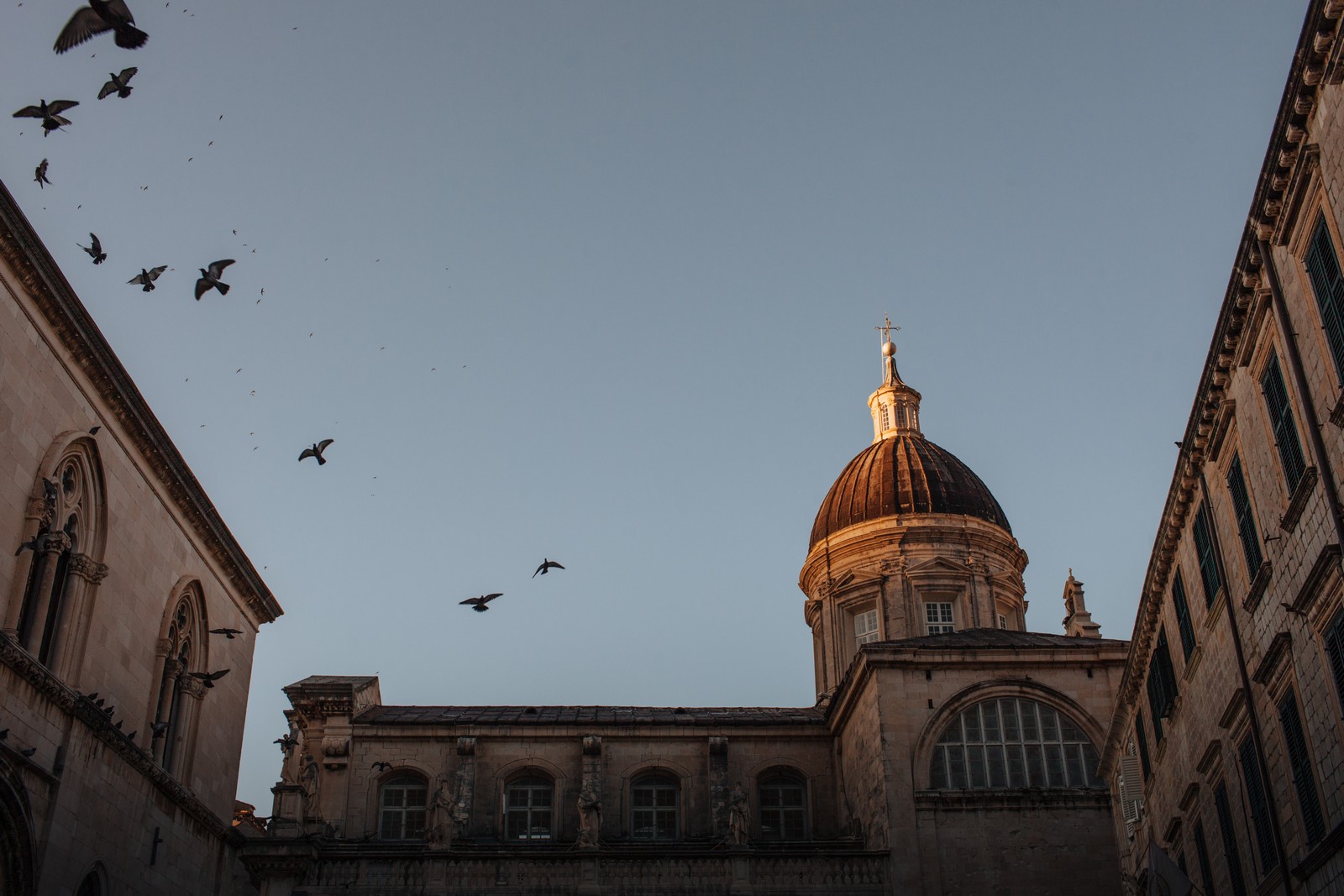
The Cathedral of the Assumption of the Virgin Mary
The Cathedral was built in the 18th century, and according to historical documents and transcripts, the previous church built in Romanesque style was a luxurious church that contained richly decorated monuments and statues and a cupola. According to the legend, the cathedral was built with the votive money donated by the English king Richard the Lionheart. He donated the money after he survived the shipwreck near the Lokrum island in 1912 when he was on his way back from the third Crusade. In 1981, the Cathedral was restored, when it was discovered that the remains of another cathedral that earlier stand at the place origins between the 6th and the 8th century. The discovery itself gave a whole new look into the early history of the city. Nowadays, the Cathedral is a home to rich relics and paintings and a popular the Assumption of the Virgin Mary from 1552.
St. Dominic’s Church
The largest church built in the Gothic style that can be found on the Croatian coast. Built according to a simple design, the church has 3 high Gothic openings and a big Crucifix by Paolo Veneziano from 1314 that is highly valued. The Monastery of the St. Dominic’s Church is a home to many paintings that include world of the popular 15th and 16th century masters that attended the Dubrovnik school of painting at that time, from Bozidarevic (Božidarević, cro.), Hamzic (Hamzić, cro.) and Dobricevic (Dobričević, cro.) plus a great canvas by the Titian with St. Blaise, the angel Raphael and St Mary Magdalene, many valuable Dominican transcripts, manuscripts, documents, the 11th century Bible and a majestic jewellery collection from some of the well-known Dubrovnik goldsmiths of that time.
Squares
If you walk in Stradun and other city streets, you’ll surely see some of the most beautiful squares in Europe.
The Marin Drzic Square
The square placed in front of the Cathedral of the Assumption of the Virgin Mary leads to the city district called “Karmen”, the city Aquarium and the city harbour. Previously called (by the locals) “in front of our Lady’s Church”, the Marin Drzic Square has some of the most important buildings in Dubrovnik, from the little Church of St. Bartholomew, the Dubrovnik Cathedral, the Sorkocevic (Sorkočević, cro.) Palace, the Memorial Room of Ronald Brown, the American Minister of Economics who died on 3 April 1996 when his plane crashed on St John’s Hill and the Dulcic-Masle-Pulitika Gallery. The square was named in an honor of a well-known Croatian poet, church organist, playwright and conspirator Marin Drzic who studied in Italy and Dubrovnik. His most popular works are Grizula (Grižula, cro.), Tirena, The Story of Stanac, Venus and Adonis, Hecuba and Uncle Maroje and The Miser. In his comedy piece called “Uncle Maroje”, he portrayed the vision of an equal society where there’s no difference between the bad and the good people.
The Ivan Gundulic Square
A statue of this famous Dubrovnik poet stands proudly in the Ivan Gundulic square. He was educated in the city where he was born and was appointed two times at the position of Rector of Konavle and a senator. He was a member of Minor Council and a representative of the Baroque style of the Dubrovnik Republic. He mostly wrote about the Catholic reformation and theories and realisation of human life. His popular works include Dubravka, Tears of the Prodigal Son and Osman, which was printed in 1826. After his death in 1638, he was buried in the Franciscan Church. The Ivan Gundulic square also has a small Amerling Fountain that dates back to the 19th century and which was destructed in 1991 during the aggression and a green market. In the southern part of the square, you’ll see a majestic Baroque square that leads to the Ruder Boskovic (Ruđer Bošković, cro.) square.
The Ruder Boskovic Square
On the Ruder Boskovic square you’ll find buildings like the church of St. Ignatius and the famous Dubrovnik Jesuit school – the Collegium Ragusinum. The church of St Ignatius was finished in 1725 and designed by the well-known Jesuit architect – Ignazio Pozzo who designed a fine Baroque building with Baroque frescoes that portrayed the life of St. Ignatius who was the founder of the order of the Jesuit. The designer of the famous steps that are leading to the Trinity dei Monti church is Pietro Passalacqua, a famous Roman architect who, in 1738, designed and finished the impressive steps.

Dubrovnik Sights – The Marin Drzic Square

Dubrovnik Sights – The Ivan Gundulic Square
Fort Imperial
The monument, Fort Imperial was built in 1810 during Napoleon’s occupation and had a strategic purpose. As the first one in the line of defence, the fort played a great role during the 1991 War of Independence. A cross that stands near was made from the Brac (Brač, cro.) stone by the “Brac-Hvar Archbishops District of Dubrovnik” in 1933. It was devastated during the war in 1991 therefore a new huge cross was built, again by the same team of Brac-Hvar Archbishops District of Dubrovnik who continued with their work after the war. Perfect place for taking pictures, and one of the favourite places among photographers, Mount Srd (Mount Srđ, cro.) offers a majestic view of Dubrovnik and everything that surrounds the city. Today, the Fort Imperial houses a museum where you can see exhibits related to the Croatian War of Independence such as shells that hit Dubrovnik and all sorts of weapons used during the war, video presentations and documents.
Lazarettos
Lazarettos were built by the people of Dubrovnik during the danger of the plague which served as isolation hospitals. From a Liber Viridis regulation that dates from 1377, we can read that all visitors who wanted to enter Dubrovnik from pestiferous areas are forbidden and had to spend forty days in special buildings on the Islands of Mrkan, Cavtat, St. Peter and Bobara. This initiated the locals to start building lazarettos to contaminate the plague and to have a quarantine before people enter the city. Merchants, seamen and all pestiferous and suspicious people who came to town, especially those coming from the areas contaminated by plague had to stay in lazarettos before entering the city. It was a smart way to prevent catastrophes that struck other major cities and countries at that time. The last Lazaretto constructed was the one placed at the eastern entrance to the Ploce (Ploče, cro.) city. The Lazaretto had 5 buildings and was finished by 1642. It was a spacious area that had its water system (at that time it was a water cistern), a physician, a priest, number of helpers and a barber-surgeon. The rules inside the buildings were rigorous and very strict. Nowadays, the Lazaretto is preserved and serves as a venue for various workshops and art performances. The monument, Fort Imperial was built in 1810 during Napoleon’s occupation and had a strategic purpose. As the first one in the line of defence, the fort played a great role during the 1991 War of Independence. A cross that stands near was made from the Brac (Brač, cro.) stone by the “Brac-Hvar Archbishops District of Dubrovnik” in 1933. It was devastated during the war in 1991 therefore a new huge cross was built, again by the same team of Brac-Hvar Archbishops District of Dubrovnik who continued with their work after the war. Perfect place for taking pictures, and one of the favourite places among photographers, Mount Srd (Mount Srđ, cro.) offers a majestic view of Dubrovnik and everything that surrounds the city. Today, the Fort Imperial houses a museum where you can see exhibits related to the Croatian War of Independence such as shells that hit Dubrovnik and all sorts of weapons used during the war, video presentations and documents.

Dubrovnik sights – Lazarettos
City Harbour
A man that was in charge of building the famous the bastion of St Luke, the entrance and other work related to harbour was Paskoje Milicevic who was born in 1440. After he finished the plans for the harbour he sent it to the Major Council who decided he can go with the construction. After he was finished with the Kaše breakwater construction, the harbour itself was saved and protected from enemies and big waves. Before the Kaše breakwater construction, the harbour was protected by a chain that was stretching from St Luke’s Fort to St John’s Fort. Milicevic was also famous for working on the Old Ponte Gate by the design of Juraj Dalmatinac. He finished his work in the early 16th century. In the 19th century, during the Austrian rule, the Porporela lungo mare breakwater and the fish market, today known as Peskarija were built.

Dubrovnik sights – City Harbour
Dubrovnik Aquarium
Dubrovnik Aquarium is one of the places in Dubrovnik that you simply need to visit. Affluent and diverse Adriatic Sea fauna and flora exhibited over 31 aquarium tanks are truly amazing. All tanks contain only fresh sea water that is run continuously and, if needed, can be changed thanks to the modern system of 4 high-pressure pumps that press 200 liters per second.
What you will see in Dubrovnik Aquarium
First, you’ll be welcomed by the domestic and charming groupers that are placed in the tank that is magnificently dug into the stone-paved floor. The next tank shows never-tired, elegant amberjacks, while the third, and the biggest tank is home to the Loggerhead turtle. You’ll be able to see dozens of cracks that are hidden under the rocks, conger eel and a vast variety of other fish. Tourists and aquarium visitors can enjoy the interesting world of the invertebrates and the sea world that is also hiding under the plants and surrounding rocks, that are barely visible to the naked eye so be sure that you take a good close look. Here, you’ll find the pulp that is guarding the territory all the time, a seahorse that is swimming really slowly, gilthead sea bream, dentex, sea bass, brown and green wrasse, sea bream, mullets, eel, kind and peaceful scorpion fishes, dangerous moray that looks like a snake, a trigger fish that is really rare and lots of spiny lobsters. The smaller tanks are home to strange looking sea sponges, corals that are shaped as live rocks or bushes, blossoming looking sea anemones, tall spirographs and cerianthus that look like small palm trees, sea urchins, starfish, conchs, crabs, sea cucumber, shells and crayfish. Here you’ll also see an exceptional Bonellia Viridis that is searching the habitat, floral sea bushes and many other interesting under-the-sea creatures. The staff of the Aquarium is professional, kind and at your assistance, so you’ll be able to find interesting facts at any time.
Lokrum Island
Dubrovnik is more than its mainland and the Lokrum Island is another great attraction while in this city. It’s only 15 minutes away from the mainland and there are plenty boat taxis that can take you there. The island impresses with both its natural and architectural treasures, and it’s the perfect place if you want to find your inner-self and to enjoy the silence. For more information on the Lokrum Island please go to our “Dubrovnik Islands” article.

Dubrovnik sights – Lokrum Island

Dubrovnik sights – Lokrum Island

Dubrovnik sights – Island of Lokrum
Dubrovnik is special for its great attractions, but also, for the vibe that it produces to whoever visits it. If you want to have an amazing experience, you should visit it as well. If you want to know more about the attractions, we recommend a guide for your tour. This way, you will know more about Dubrovnik’s culture and history.